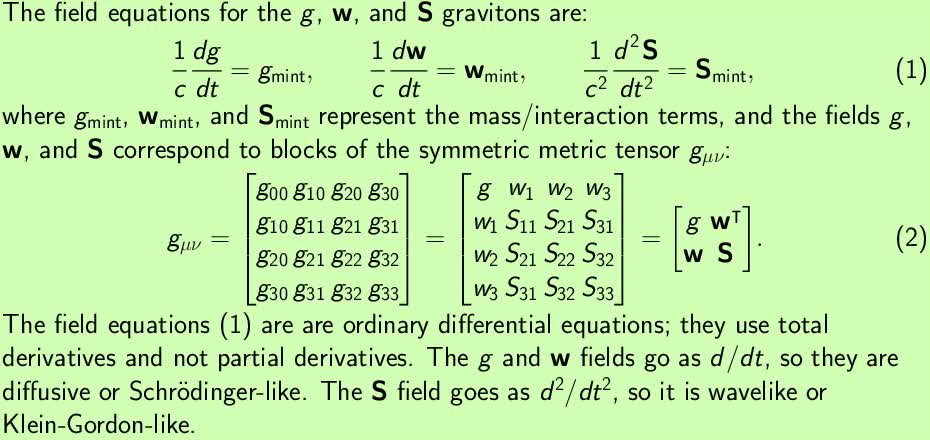
I have quantized gravity, space, and time.
| |
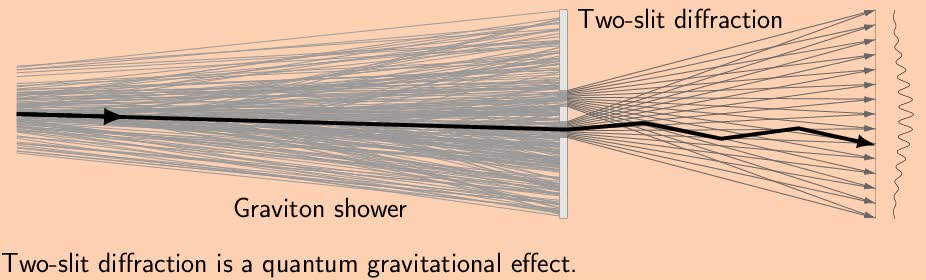
Three new kinds of gravitons explain inertial reference frames, classical quantum
mechanics, and dark matter.
| |
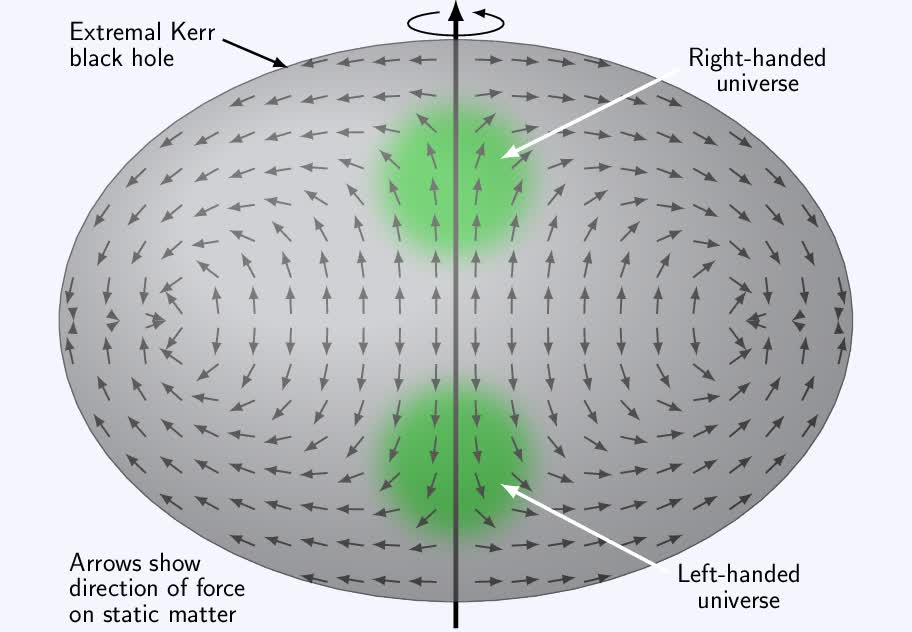
Parity violation occurs because our universe is inside an extremal
Kerr black hole.
| |
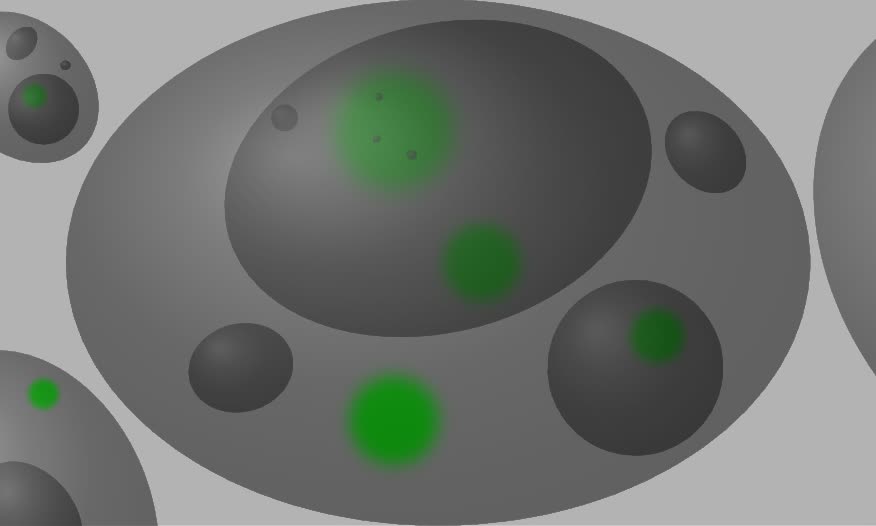
Our universe is part of the holoverse, which consists of black holes nested within black holes, ad infinitum.
| |
The spot on my forehead is a natural bindi, signifying an
open third eye, which means that I have infinite wisdom. The scar on my upper
lip is from face-planting on a rock while out hiking with my wife, which means
that I am a klutz.
| |
📌Oct 18, 2026: Abstract submitted for a talk
and a poster at the APS Global Physics Summit, April 11-16, 2027, Atlanta
GA:
Announcing the Creation
Toolkit 1.0
The
Creation Toolkit 1.0 will be officially launched at the 2027 APS Global Physics
Summit. The goal of the Creation Toolkit is to exactly create a portion of our
universe on a computer, or network of computers, by exactly simulating the laws
of physics in software. Exactly simulating the laws of physics is now possible
due to advances in absolute gravity (AG), absolute quantum gravity (AQG),
absolute electrogravity (AEG), and quantum electrogravity (QEG). The Creation
Toolkit 1.0 focuses on vacuum physics. The two operating modes are approximate
classic mode and exact quantum mode. The approximate classic mode, which is
based on AG, creates simulations that can be compared to general relativity via
the Einstein Toolkit and LVK data. The Creation Toolkit 1.0 can simulate the
interiors of black holes, or collisions of several black holes with arbitrary
spins and masses, on a laptop with 16GB of RAM. In exact quantum mode, the
Creation Toolkit 1.0 uses AQG to exactly create the physics of our universe.
Space, time, and gravity are quantized. Gravity is transmitted by the three
kinds of AQG gravitons. This talk will be a brief introduction to using the
Creation Toolkit, with colorful pictures and movies. Detailed discussions will
be left to the associated poster session.
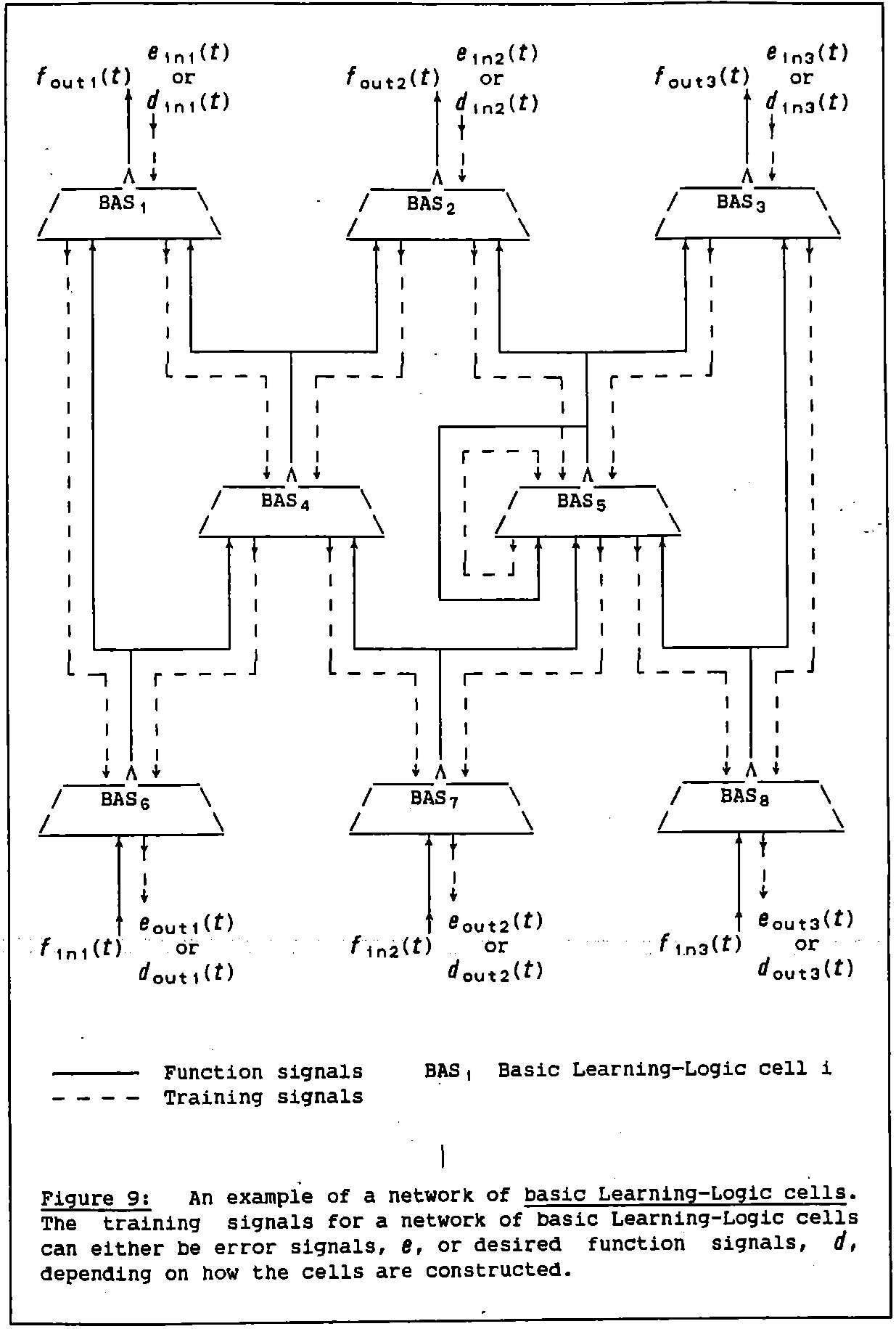
A backpropagation network.
It illustrates deep learning (multiple layers with a hidden layer) and recurrent learning
(the right-hand cell in the hidden layer has a recurrent feedback connection).
The 1982 Stanford patent process for backpropagation
became moot when I learned of Paul Werbos's earlier work (see my 1987
paper).
Figure 9 from Learning-Logic:
Casting the Cortex of the Human Brain in Silicon, Feb, 1985. |
|
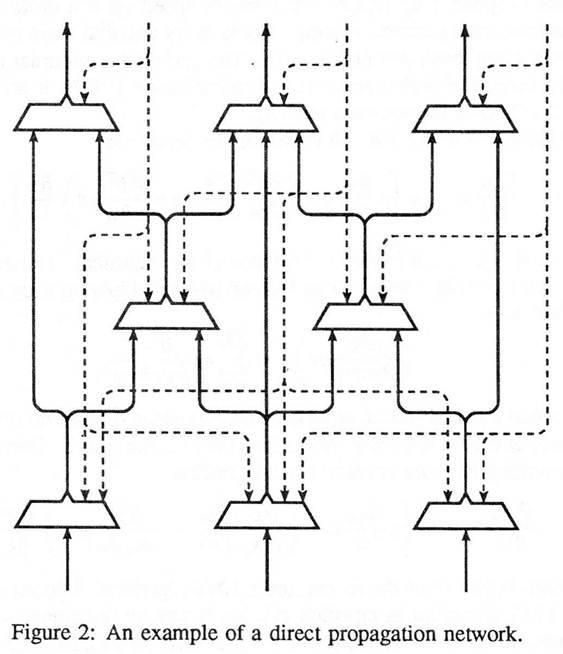
A direct propagation network,
although I now think deep backpropagation would be a better name. The signals are not
constrained to going layer-by-layer, but instead can propagate directly through
multiple layers. Deep backpropagation leads to a better approximation to
optimal 2nd order backpropagation.
Figure 2 from
Optimal
Algorithms for Adaptive Networks: Second Order Back Propagation, Second Order
Direct Propagation, and Second Order Hebbian Learning, Jun, 1987. |
|
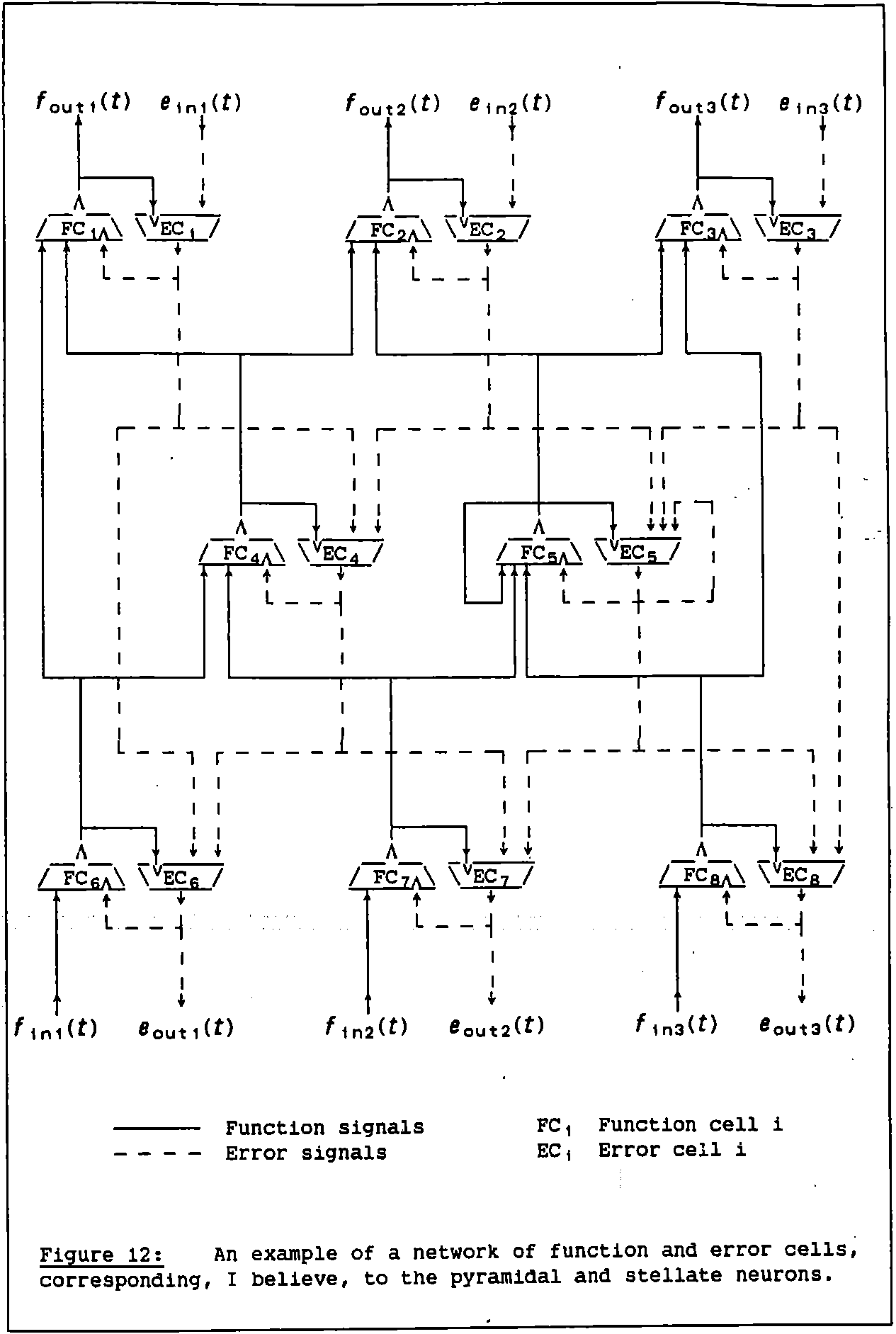
Splitting the backpropagation
cells into separate function and error cells yields an even more brainlike
structure, especially when combined with deep backpropagation. Splitting
the cells gives the error cells a chance to independently optimize the error
signals. The function and error cells may correspond to the pyramidal and
stellate neurons in our brains. Figure 12 from Learning-Logic:
Casting the Cortex of the Human Brain in Silicon, Feb, 1985. |
Absolute quantum gravity (AQG) (talk)
I have quantized general relativity. The result is a set of three new kinds of
gravitons: a scalar g graviton, a vector w graviton, and a matrix
S graviton. The S graviton is the "fast" graviton; its field
equation goes as d2/dt2, like the wave equation or the
Klein-Gordon equation. S gravitons are responsible for the long range
gravity waves observed by LVK. In vacuo, S gravitons move at the same
speed as photons. The g and w gravitons are the "slow" gravitons;
their field equations go as d/dt, like the diffusion equation or the
Schrödinger equation. Among other effects, g and w gravitons
are responsible for inertial reference frames (which are an effect of graviton
atmospheres) and classical quantum mechanics (which arises from particles
diffusing through graviton atmospheres). The field equations for the three new
kinds of gravitons follow exactly from Einstein's equation, maintaining the
physics of general relativity. But the hypothesis of general covariance (that
the laws of physics will have the same form in all reference systems), which is
false in classical quantum mechanics, is also false in absolute quantum gravity
because the g, w, and S gravitons move in absolute
space and time.
Absolute quantum gravity (AQG) and quantum electrogravity (QEG) (poster)
Absolute quantum gravity (AQG) quantizes general
relativity. AQG results in three new kinds of gravitons: a scalar g
graviton, a vector w graviton, and a matrix S graviton. Quantum
electrogravity (QEG) adds electromagnetism to AQG. I believe that QEG is the
Grand Unified Theory. I do not believe there is a Grander Unified Theory that
adds the weak and strong forces, because so far it appears that the interactions
between the AQG gravitons and charged particles can account for both the weak
and strong forces. This poster will expand on topics covered in my talk on AQG.
It will also include updates on the rapidly progressing theoretical and
simulation results in AQG and QEG. Depending on what is ready to be released by
the time of the conference, the theoretical results may include: formulas
similar to propagators and vertex factors for both AQG and QEG; possible new
experimental tests; a periodic table of the particles based on bound graviton
states; and a calculation of the fine structure constant. The simulation
results may include: a hydrogen atom; rotating galaxies inside an extremal Kerr
black hole; a dynamic simulation of the graviton showers in single-particle
two-slit diffraction (which looks similar to the Plinko game); and a general
purpose AQG/QEG simulator.